How to Make Viral Animated Story Videos with AI
Colorful hand-drawn story shorts — a curiosity question, a few doodle scenes, a voiceover. Simple to watch, deceptively specific to get right. Here's the whole recipe.
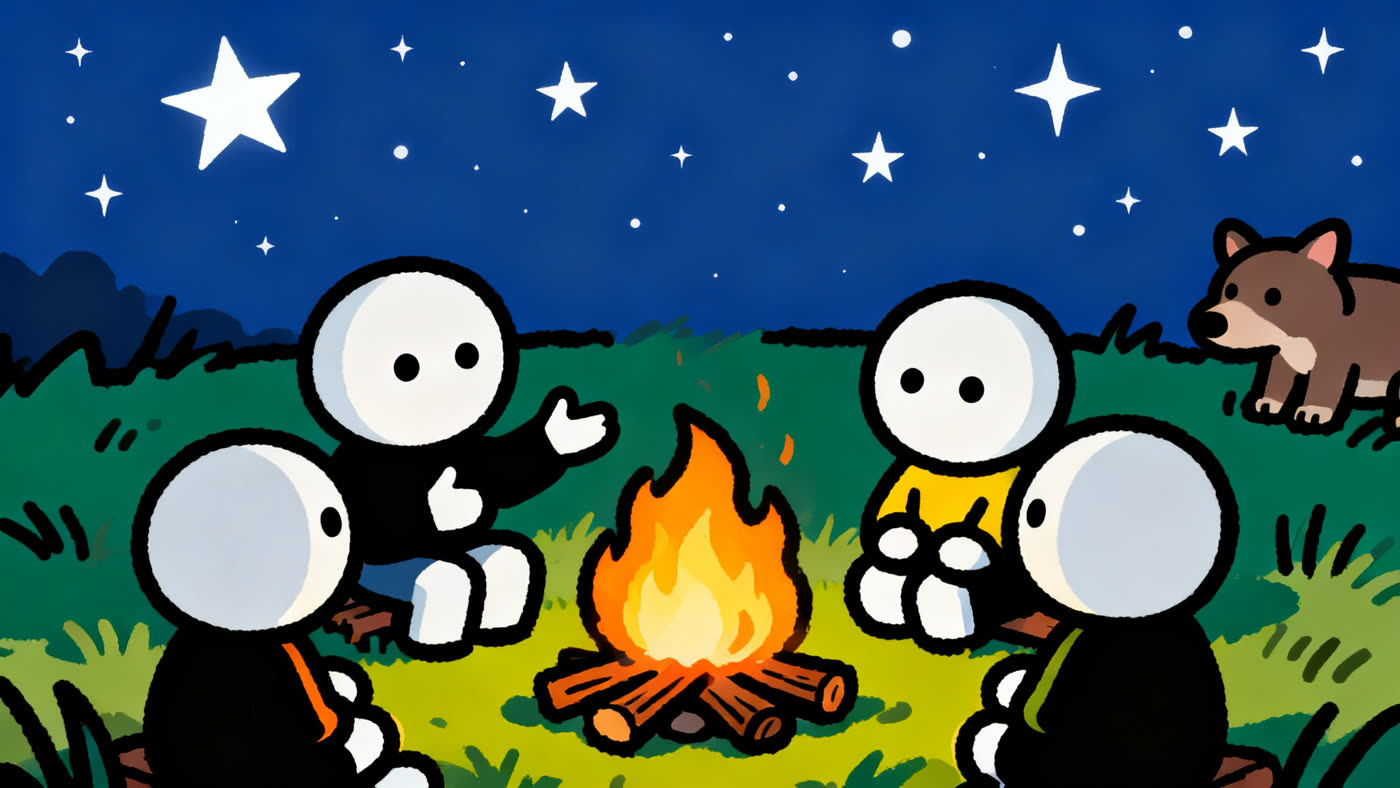
You've seen them: a colorful hand-drawn cartoon, a voice asking something like "What did ancient humans actually do all day?", and a new doodle for every sentence. Channels built entirely on this format have pulled millions of views from a standing start. It looks effortless. It isn't — but the parts that make it work are learnable, and the drawing is the part AI now does for you.
This is a walkthrough of the animated story format: what it is, why the videos that pop actually pop, and how to make one end to end. We make ShortsMade, which has an Animated Story generator built for exactly this — so the how-to section uses it — but the format thinking applies no matter what you build with.
What an animated story video actually is
Strip it down and it's four things stacked together:
- A curiosity question as the title and opening line — the hook that makes scrolling past feel like leaving a question unanswered.
- A short narration that answers it in interesting beats, one idea at a time.
- One hand-drawn doodle per beat — thick outlines, flat bright colors, round-headed characters — that literally illustrates what's being said.
- Captions and a voiceover that keep the pace tight enough for a 30–60 second short.
It is NOT frame-by-frame animation. Nobody is animating a walk cycle. Each scene is a single still illustration with a slow zoom and a crossfade into the next — which is exactly why one person can publish daily. The "animation" is the pacing, not the drawing.
Why the good ones go viral (and the rest don't)
We pulled the top-performing videos from the biggest channels in this niche and the pattern is almost boringly consistent. Two things separate the millions-of-views videos from the ones stuck at 800:
1. The title is a question you didn't know you wanted answered
Not "Facts about ancient humans." It's "What did ancient humans do all day before jobs existed?" The first is a topic. The second is an open loop — your brain wants it closed. Every reliable performer in this format is phrased as a question, and the best ones are about something you already half-wondered but never looked up.
2. The topic does more work than the volume
The channels that broke out did it on a handful of videos, not hundreds. The winning topics cluster hard: ancient and early humans, the relationship between animals and humans, the deep ocean and creepy corners of nature, and death and the brain. These are "I never thought about that" subjects — big, slightly eerie, universally relatable. Pick the topic well and an average execution still travels. Pick it badly and a perfect execution won't.
A curiosity question about a big, slightly-eerie, universal topic, answered in tight beats with a doodle for each. Get those two bolded things right and you're most of the way there.
How to make one with AI, step by step
Here's the actual workflow in ShortsMade's Animated Story tool. Start to finished MP4 is a couple of minutes.
- Pick a topic — or don't. Choose one of the viral-tested angles (ancient humans, the deep ocean, animals & humans, death & the brain, evolution & survival), type your own, or hit "Surprise me" and let the AI pick a fascinating one for you.
- Generate the story. The AI writes a curiosity-question title and splits the narration into beats, and for each beat it writes the doodle scene to draw. Every line is editable — rewrite the title, tweak a beat, before anything is rendered.
- (Optional) Turn on a recurring character. This locks one doodle protagonist — a little guide — into every scene so the video feels like a story with a narrator rather than a slideshow. It draws a reference character first, then keeps them consistent across beats.
- Set voice and style. Pick a narration voice and speed, a caption preset, and background music. Aspect ratio is locked to 9:16 for Shorts, Reels, and TikTok.
- Generate the video. Each beat becomes a premium doodle illustration, timed to the voiceover with a slow zoom and crossfades, captions burned in. It lands in your library as a ready-to-post MP4.
If a single scene comes out wrong, you don't re-roll the whole video — the timeline editor lets you fix that one beat and re-export. That's the difference between a toy and something you'd actually post.
What it costs to make one
Being upfront, because most tools aren't: an animated story short generates one AI illustration per beat, and those illustrations are the real cost. A 30-second video runs about five scenes. In ShortsMade that's priced so a free account can make one — a 30-second animated story is 20 credits, and new accounts start with credits included, no card. Longer videos cost more because they have more scenes to draw.
What this format is good and bad at
| Great for | Not the move for |
|---|---|
| Curiosity / "did you know" educational shorts | Fast-cut hype or trend-chasing clips |
| Storytime, history, science, nature, psychology | Anything needing real footage or a real face |
| A recognizable, ownable channel look | Photorealism — this is deliberately a cartoon |
| Daily posting by one person | Frame-accurate motion / lip-sync animation |
Animated Story makes 9:16 shorts only right now — no long-form yet. There's no auto-posting or recurring series: you generate and download, then post yourself. And it's a cartoon by design, so it's the wrong tool if you need realism.
Animated story vs. Reddit story
They're the two dominant faceless-story formats and they win in different places. Reddit stories run a narrated thread over gameplay footage — great for drama, confessions, and revenge arcs. Animated stories illustrate every beat — great for curiosity, education, and anything where seeing it drawn adds something. If your topic is a personal drama, the Reddit story format fits better; if it's "how does X actually work," draw it. Both live in the same tool, so you don't have to marry one.
Whichever you pick, the thing that decides the outcome is the same: the hook and the topic. For more on that side of it, our rundown of faceless video tools and formats and our notes on captions that keep viewers watching both transfer directly.
What are animated story videos called?+
There's no single agreed name — you'll see "doodle story," "animated storytime," "cartoon shorts," and "curiosity shorts." They all describe the same format: a narrated short where each beat is illustrated as a hand-drawn cartoon scene.
Do I have to be able to draw?+
No. The whole point of doing this with AI is that the drawing is generated. You write (or generate) the story; the tool draws every scene in a consistent doodle style.
How long should an animated story video be?+
For Shorts, Reels, and TikTok, 30–60 seconds is the sweet spot — roughly five to eleven beats. Long enough to answer the question satisfyingly, short enough to hold retention to the end.
Can I keep the same character across videos?+
Within a single video, yes — recurring-character mode locks one protagonist across every beat. A persistent mascot reused across many videos is a natural next step, but treat consistency within one video as the reliable feature today.
Can these get monetized on YouTube?+
Yes. An original script, a coherent channel identity, and real editing choices are what monetization policy asks for — AI as the drawing tool isn't the problem. Re-uploading the same template on a loop is.
Pick a topic, or let it surprise you — your first animated story short is a couple of minutes away.
Make an animated story free